
Learn every constellation by heart.
Star Scholar teaches you to recognise all 88 IAU constellations — and then makes you prove it, by drawing them from memory against the real sky above you tonight. Entirely offline: no account, no server, no tracking.
Features
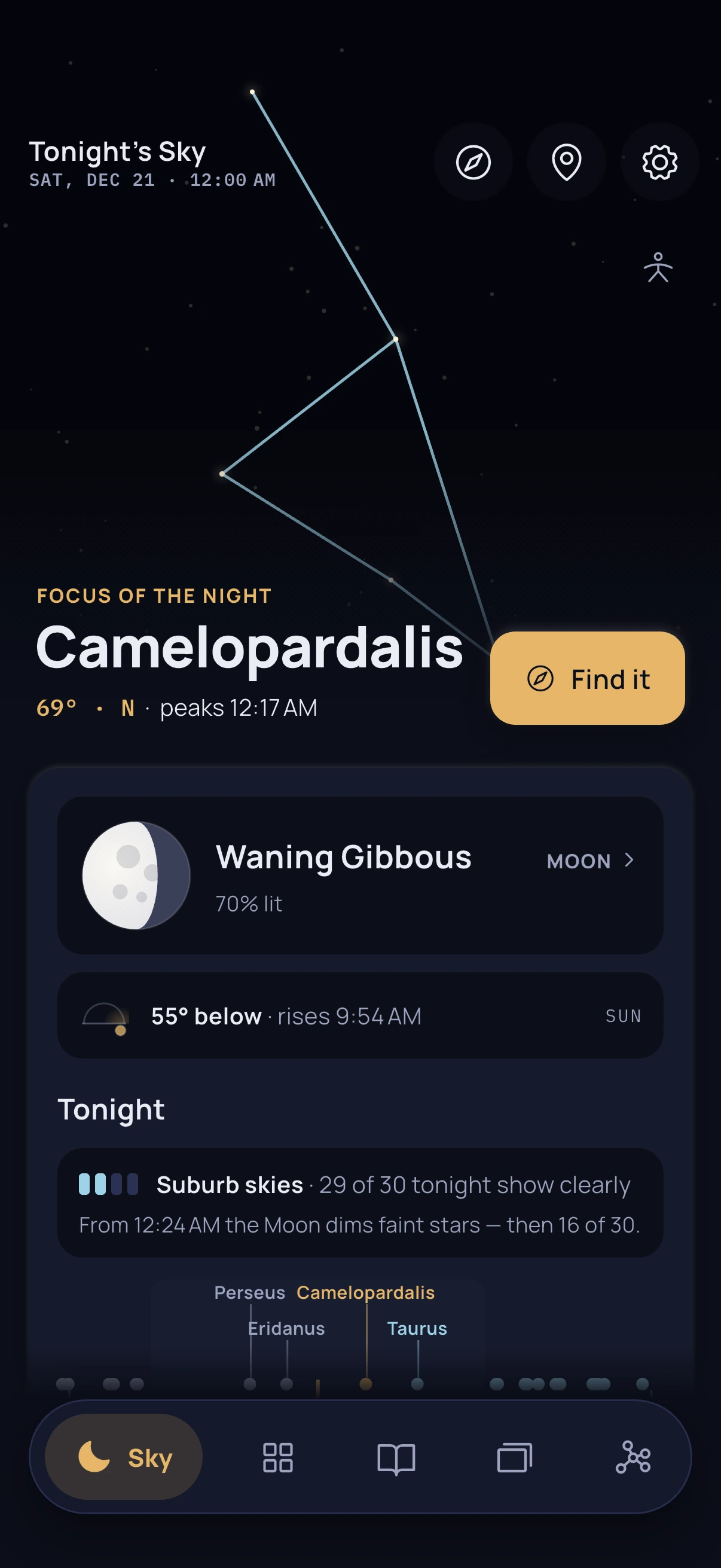
Tonight's Sky
What is actually above your horizon right now, ranked by altitude, with the moon phase and the sun position that decide whether it is worth going outside.
Catalog
All 88 IAU constellations, searchable and filterable by hemisphere, season, and difficulty. Every one drawn as its real star pattern, not an illustration.
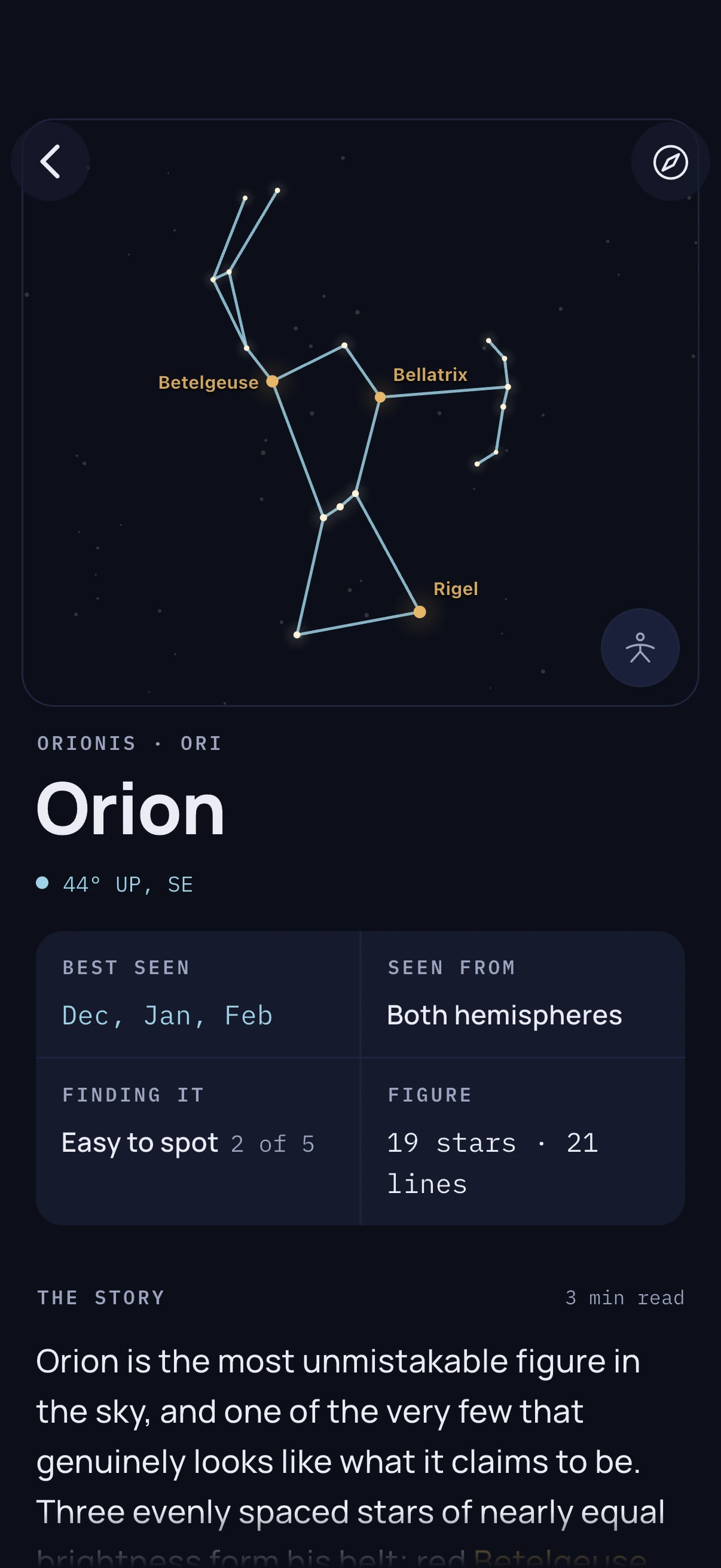
Constellation detail
The star pattern at full size, the mythology behind the name written from scratch, and the viewing metadata that tells you when and where to look.
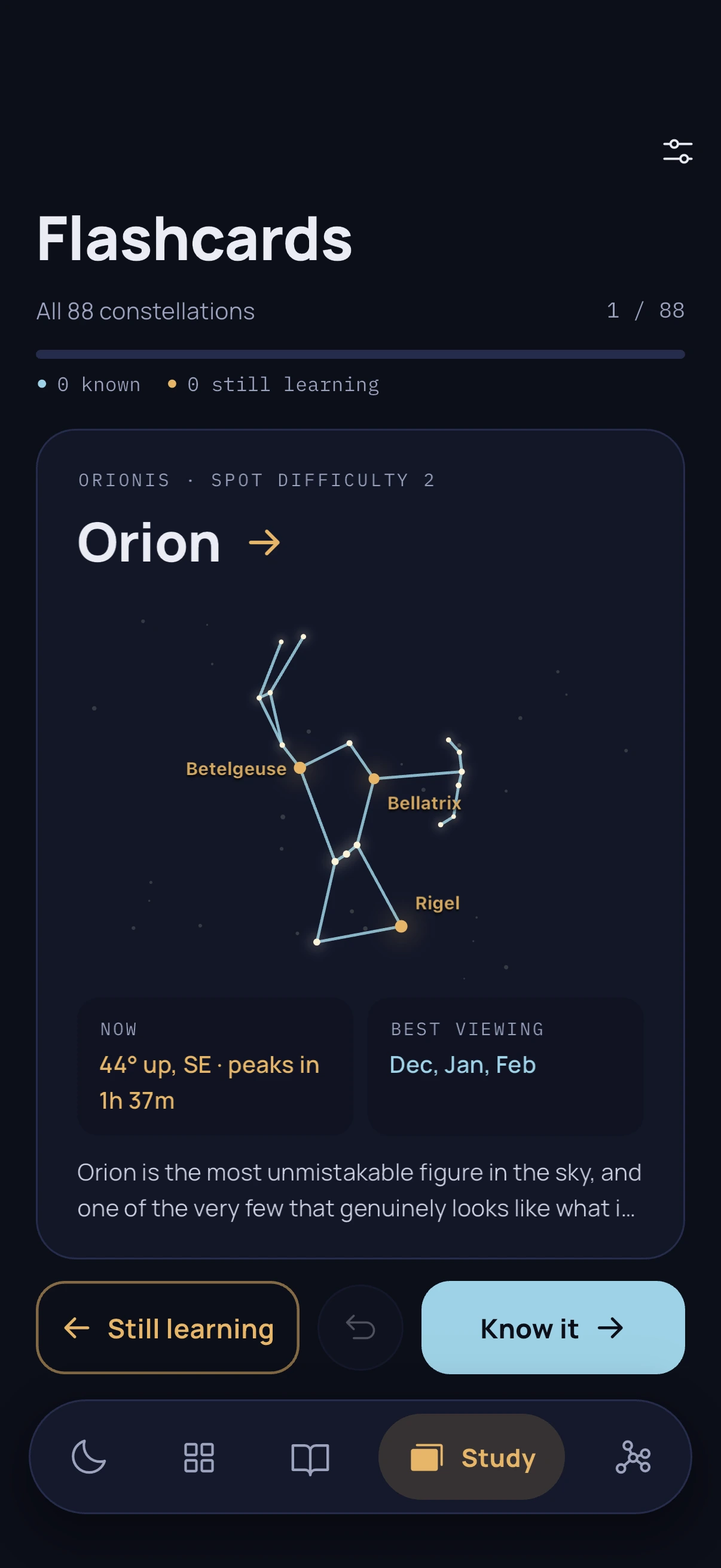
Flashcards
Recognition practice, one pattern at a time, tracking what you know and what you are still learning so the deck narrows to the ones that keep catching you out.
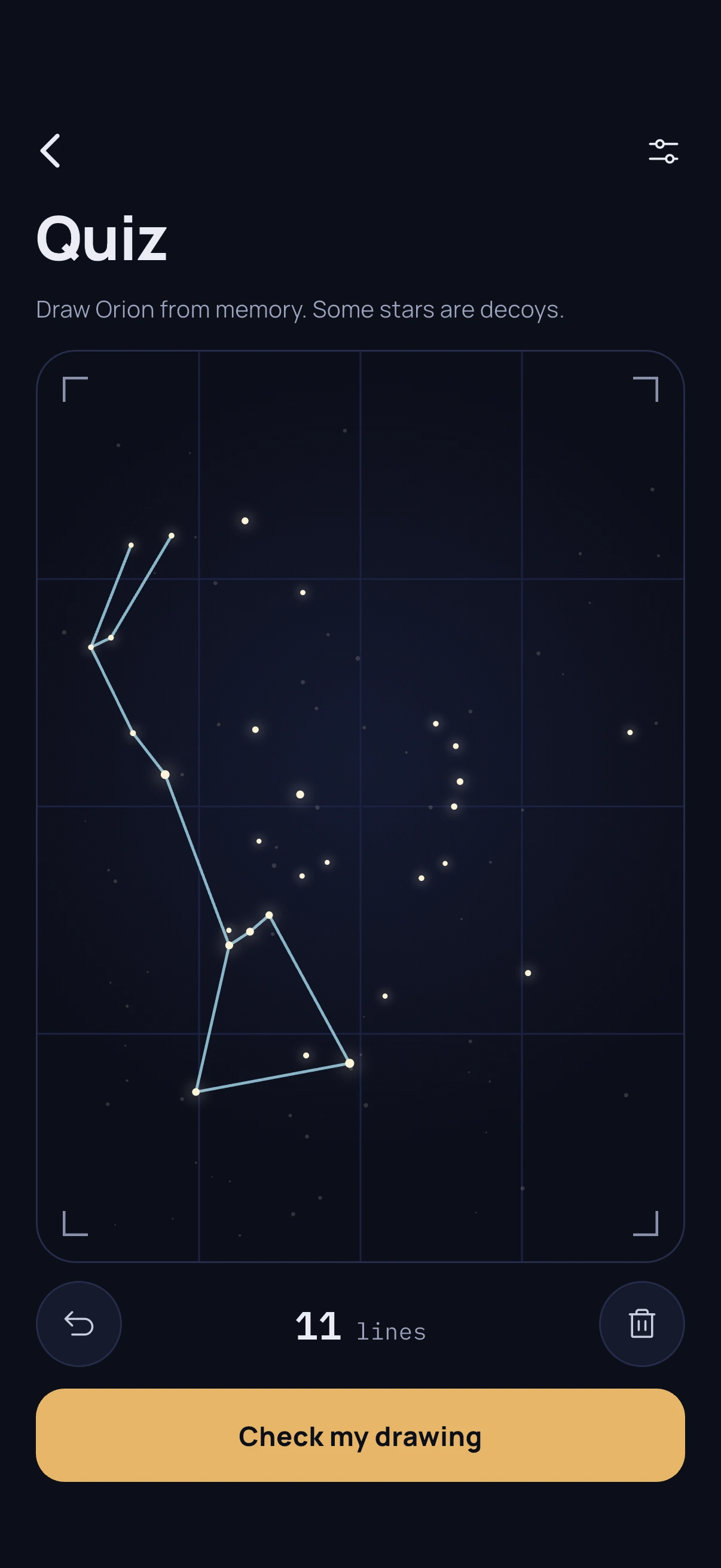
Quiz Mode
Connect the stars from memory on a bare star field and get graded line by line against the canonical pattern. This is the reason the app exists.
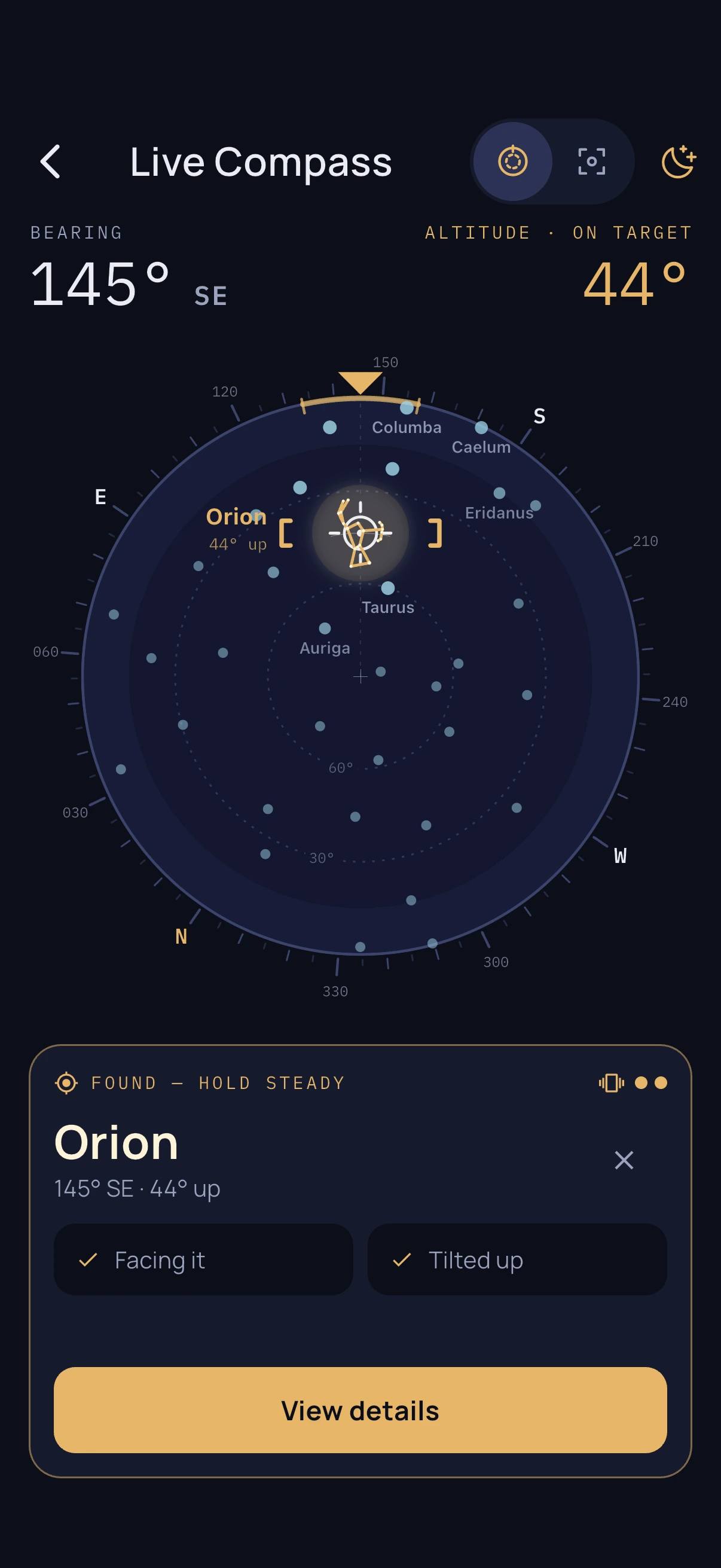
Location and compass
GPS, manual coordinates, or an offline city search — your call. Point your phone at the sky and the live compass shows you which way to face.
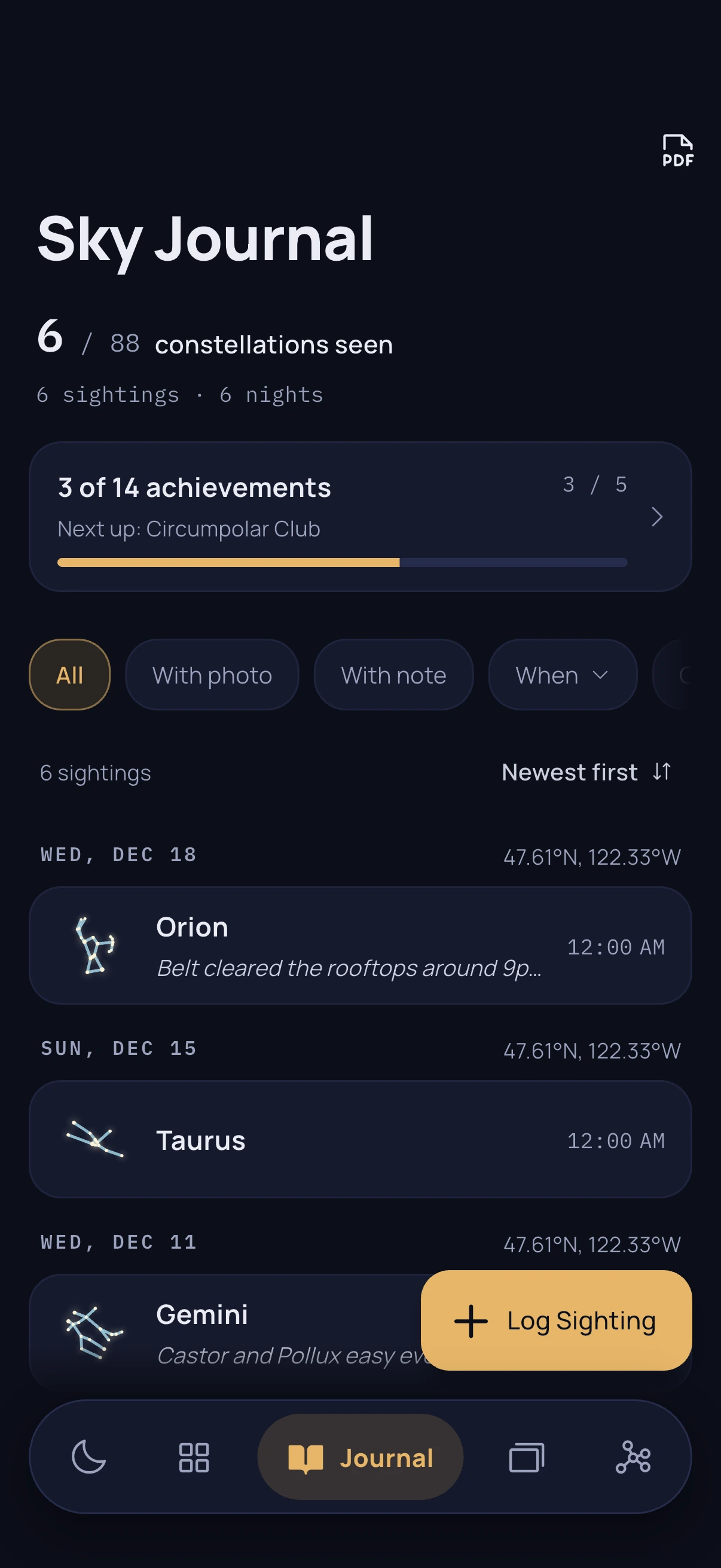
Sky Journal
Log the constellations you actually find in the sky. Each sighting keeps its date, your observing location, a note and a photo — and the whole log exports as a formatted PDF. The same screen holds your achievements: milestones for the zodiac band, the circumpolar five, a perfect quiz, ten constellations seen for real — earned for what you have done, never for how often you open the app.
How it works
- Learn it. Work through the catalog and drill with flashcards until the shapes are familiar. The app marks what you already know so you spend your time on what you do not.
- Prove it. Open Quiz Mode, draw the constellation on a bare star field, and see exactly which lines you got right.
- Find it. Set your location — GPS, manual coordinates, or an offline city search — then point your phone at the sky and the live compass shows you which way to face.
- Log it. Every constellation you track down goes in your Sky Journal with the date, where you were, and a photo if you took one. Achievements mark the milestones — the whole zodiac, the constellations that never set, your first ten sightings — and the journal exports to PDF whenever you want it on paper.
It works with your phone in airplane mode.
The entire star catalog, all 88 constellation patterns, and the city list are compiled into the app at build time from public astronomical datasets. There is no backend to be down, no account to create, and no analytics or advertising SDK anywhere in it. Star Scholar makes no network calls at runtime — which is a design decision, not a roadmap item, because the best stargazing happens where there is no signal.
- No account and no sign-in
- No servers, no sync, no cloud backup
- No analytics, crash reporting, or ad SDKs
- Your location never leaves your device
Frequently asked questions
Does Star Scholar work offline?
Completely. The star positions, all 88 constellation patterns, and the city database are bundled inside the app, so every feature works in airplane mode and in the middle of nowhere. The app makes no network calls at runtime at all.
Do I need to create an account?
No. There is no account system, no sign-in, and no server behind the app. You open it and start learning.
Why does it ask for my location?
So it can work out which constellations are above your horizon right now. The app requests a single reading — it does not track you and does not run in the background — and that reading is stored only on your device. You can skip it entirely and type coordinates or search for a city instead.
How many constellations does it cover?
All 88 constellations recognised by the International Astronomical Union, each with its real star pattern, its brightest stars, and an original write-up of the mythology behind the name.
How accurate are the star positions?
Positions are computed from the HYG database and are accurate enough to identify and locate constellations from anywhere on Earth. Star Scholar is a learning tool, though — it is not a navigation instrument and should not be relied on for maritime, aviation, or other safety-critical orientation.
What makes Quiz Mode different from a normal quiz?
It is not multiple choice. You are given a bare field of stars and you draw the constellation yourself, line by line, from memory. The app grades each line against the canonical pattern and shows you which connections you got right, which were wrong, and which you missed.
Can I keep track of the constellations I've seen?
Yes. The Sky Journal logs each constellation you spot in the real sky, with the date, your observing location, an optional note, and an optional photo. It is kept separate from what the app considers you have learned, so resetting your study progress never touches it, and you can export the whole journal — filtered or complete — as a formatted PDF.
Does Star Scholar send notifications?
Only if you turn them on, and only one kind. With notifications enabled, the app sends an occasional evening heads-up when a constellation you have not learned yet is well placed after dark — worked out on your device from your location. No streaks, no daily reminders, and nothing nagging you to come back.
Is Star Scholar suitable for children?
Yes. It collects no personal information from anyone of any age, contains no ads and no in-app purchases, and the mythology write-ups are written for a general audience.
Is it free?
Yes. Star Scholar is free to download, with no subscription, no ads, and no in-app purchases.
Get Star Scholar.
Available on the App Store and Google Play. Free to download, no subscription, no ads, no in-app purchases.
Privacy Policy · Terms & Conditions · support@maykrware.com
Star data from the HYG Database (CC BY-SA 4.0), constellation lines from d3-celestial (BSD-3-Clause), and city data from GeoNames (CC BY 4.0). All mythology text is original.
Loading Star Scholar…